
It is 5:47 AM in Rajshahi. The sky is still bruised purple when Shireen Akter straps her weather-beaten satchel across her shoulder and kicks her bicycle onto the dirt road. She is not a teacher. She is not a headmaster. She is something far more unusual in the machinery of global education: a Programme Organiser for BRAC, responsible for the heartbeat of twelve learning centres scattered across floodplains, bazaar edges, and villages that Google Maps has forgotten. By sunset, she will have travelled twenty-three kilometres, mediated a land dispute over a school shed, and convinced a father that his daughter's future is worth more than her dowry. This is how BRAC runs.
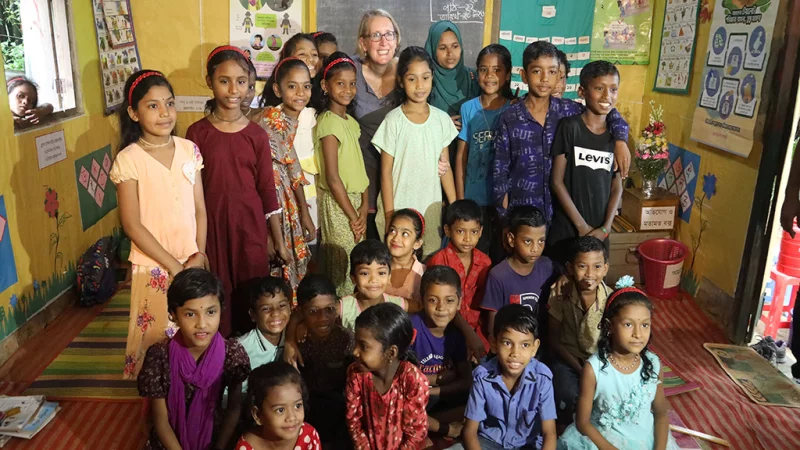
Inside a BRAC learning centre in rural Bangladesh — where the classroom is the community
The Shed on Stilts
In the village of Chawkider, the school meets under a bamboo shed raised on stilts because the monsoon turns the ground into a lake for three months a year. The blackboard is a slab of painted tin. The students sit on rice sacks. Yet when Shireen arrives at 8:15 AM, the teacher — a 19-year-old named Ruma who grew up three houses away — has already drawn the solar system in coloured chalk and is quizzing a girl on the orbit of Jupiter. Shireen does not interrupt. She stands at the threshold, watching. She carries a clipboard, yes, but her real instrument is her eyes.
"You cannot manage a school from an office in Dhaka. You must smell the mildew on the walls. You must know which child came without breakfast. That is the data that matters."
The architecture of trust
To understand how BRAC manages its education empire — over 40,000 centres, 1.2 million students, 98% of them from families living below the poverty line — you must first abandon the image of a corporate headquarters issuing memos. BRAC's management model is biological, not mechanical. It grows from the soil up.
Every school is born from a negotiation. Before a single child sits down, BRAC staff hold shalish — community arbitration meetings — under banyan trees and in mosque courtyards. They do not announce a school. They ask a question: Do you want this? Are you willing to give a room, a corner, a veranda? Will you form a committee of mothers and fathers who will guard this place as if it were their own? Only when the village says yes does the paperwork begin. The management chain, in other words, starts with consent.
By the Numbers
3,500+ Programme Organisers like Shireen crisscross Bangladesh by foot, bicycle, and boat.
98% of BRAC teachers are women recruited from within a two-kilometre radius of their school.
40,000+ learning centres operate without a single brick-and-mortar building owned by BRAC.
The making of a teacher
At 10:30 AM, Shireen reaches the BRAC branch office — a rented room above a pharmacy — where six young women are waiting for their interview. They are not here because they saw a job posting online. They are here because their neighbours recommended them. BRAC's recruitment protocol is deliberately localised: a teacher must live within walking distance of her students. She must share their dialect, their diet, their fears. She must be someone a mother can summon at dusk if a child falls ill.
The selected candidates are sent to a residential training centre for fifteen days. They learn to teach arithmetic using pebbles and sticks. They practise classroom management in a simulated tin shed with no electricity. They are taught to spot the signs of child marriage, malnutrition, and abuse — because in BRAC's world, a teacher is also a sentinel. Then they return. Not as employees of a distant NGO, but as daughters of the village who happen to hold chalk.
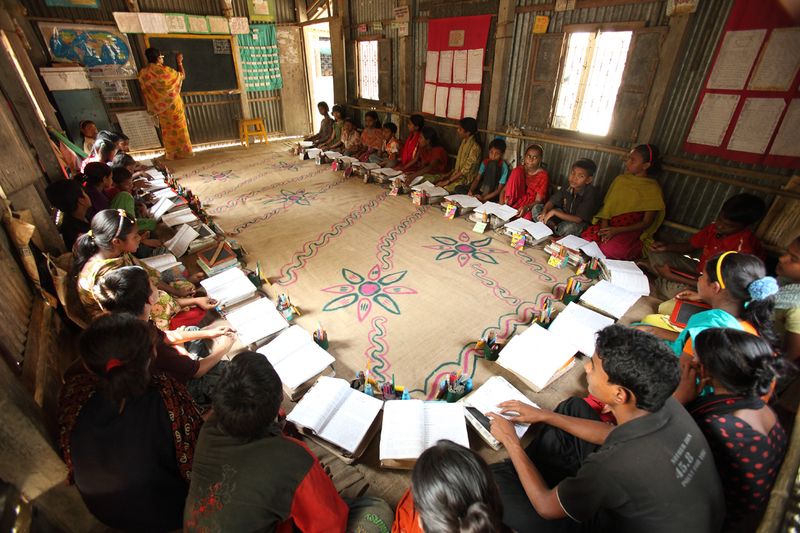
A BRAC classroom where community and learning intertwine
The Committee That Never Sleeps
Every BRAC school is shadowed by a School Management Committee — usually five to seven parents, a local shopkeeper, perhaps the imam, and an elderly grandmother who has seen too many children grow up illiterate. They meet monthly, often by lamplight. Their agenda is never abstract. They discuss whose father has threatened to pull a daughter out for harvesting. They inspect the register to see who has been absent for three days. They collect five taka from each family — not because BRAC needs the money, but because people value what they pay for. This committee is the immune system of the school. It detects infection before the headquarters in Dhaka even knows a fever exists.
The tablet and the bicycle
By early afternoon, the heat has turned the dirt roads into powder. Shireen stops under a mango tree and pulls out her tablet. It is cracked along one edge, held together with electrical tape, and it contains the nervous system of her entire territory. She opens the monitoring app and records the morning's observations: attendance at the Chawkider centre is 94%, Ruma's lesson plan was followed, two students need reading glasses, one boy has not eaten in two days. The data does not travel upward to be filed away. It travels upward to be acted upon. By evening, a regional manager in Rajshahi city will see Shireen's notes. By tomorrow, a health worker will visit the hungry boy's house. By next week, an optometrist will come to the school.
This is the paradox of BRAC's management: it is simultaneously one of the most decentralised education systems on earth and one of the most obsessively monitored. The centre in Dhaka does not command. It listens. It gathers thousands of these small field notes and looks for patterns — a spike in dropouts after the rice harvest, a correlation between teacher absenteeism and distance from the main road — then adjusts policy like a navigator adjusting a sail.
The Road Home
It is past six when Shireen finally turns her bicycle toward home. Her sari is dusted ochre. Her satchel is lighter — she has distributed all the pamphlets on girls' scholarships. She passes a group of children walking back from a government school, and one of them — a girl who graduated from Shireen's own BRAC centre three years ago — calls out to her. Apa, I came first in my class.
"People ask me how BRAC manages so many schools. I tell them: we don't manage schools. We manage relationships. A school is just a room where trust has been allowed to sit down."
Tomorrow she will wake again at 5:47. The purple sky. The dirt road. The twelve classrooms that exist because a village decided they should.
BRAC's education programme is often measured in numbers — millions enrolled, percentages passed, dollars spent. But its true operational genius is invisible to spreadsheets. It is the grandmother on the School Management Committee who notices a bruise. It is the Programme Organiser who cycles through monsoon mud because a register showed three absences. It is the understanding that in a country where the state cannot reach every child, the community can — if someone simply asks them to, and then gets out of the way.
BRAC began its education journey in 1985 with twenty-two experimental schools in Manikganj. Four decades later, its management model — built on community ownership, female field leadership, and real-time data feedback — has been adapted in Uganda, Tanzania, Afghanistan, and beyond. The organisation remains the world's largest non-governmental provider of education, not because it built the most buildings, but because it learned how to build trust.