
What is BRAC Education Program (BEP)?
A Complete Guide
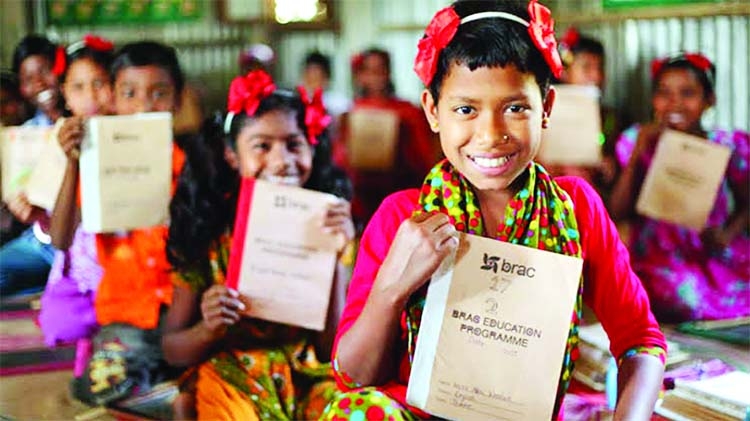
"Education is not a privilege. It is a fundamental right — and BRAC made sure no child is left behind."
1. What is BEP? Definition & Core Purpose
The BRAC Education Programme (BEP) is the flagship education initiative of BRAC, the world's largest non-governmental development organization. Launched in 1985, BEP was designed with one clear mission: to bring out-of-school and disadvantaged children into the fold of institutional education.
At its heart, BEP exists because millions of children in Bangladesh — especially girls, children from ultra-poor families, ethnic minorities, and children with disabilities — were systematically excluded from the formal education system. Poverty, distance, gender discrimination, and disability created barriers that traditional schools simply could not break.
BEP does not compete with the government education system. Instead, it complements and fills the gaps — reaching children who have dropped out, never enrolled, or are at risk of dropping out. It follows the national curriculum but delivers it through a flexible, child-centered, and community-owned approach.
2. The Core Model: The One-Teacher School
The most iconic and revolutionary concept behind BEP is the One-Teacher School model. It is brilliantly simple, incredibly cost-effective, and proven to work at massive scale.
🏠 One Room, One Teacher, One Cohort
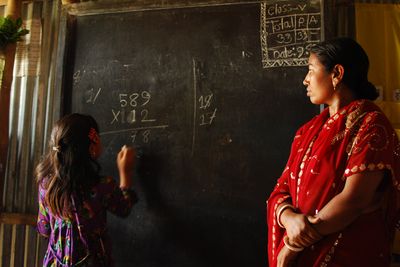
Instead of building expensive school buildings, BRAC rents a single room within the community — a space in a villager's home, a community centre, or a simple bamboo structure. A single teacher, usually a local woman with 10–12 years of schooling, is trained and placed in charge.
This one teacher takes a single cohort of 25–33 students and stays with them for the entire primary education cycle (typically 4 years in an accelerated format). She teaches all subjects, tracks every child's progress, and builds deep personal relationships with both students and their families.
📋 Key Features of the Model
- Small class size: 25–33 students per school (vs. 50+ in many government schools)
- Flexible timing: School hours decided by parents and teachers together
- Free education: No tuition fees, free books, and free learning materials
- Local recruitment: Teachers are hired from the same village
- Community ownership: A School Management Committee (SMC) oversees operations
- Low cost: Approximately $45 per learner per year
3. The Five Sectors of BRAC Education
BEP is not limited to primary schooling. It operates across five interconnected sectors, creating a seamless educational journey from early childhood to secondary transition.
Play Labs (Early Childhood Development)
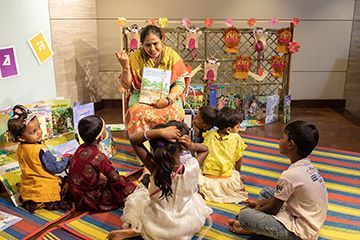
BRAC Play Labs are creative, play-based learning spaces for children aged 3–5 years, especially in underserved communities and humanitarian settings. These labs use guided play — storytelling, music, art, and games — to develop cognitive, social, emotional, and motor skills.
Play Labs are often set up in refugee camps, urban slums, and rural villages where formal pre-primary facilities are nonexistent. The approach is backed by research showing that play is one of the most powerful tools for early brain development.
Pre-Primary Education
Before children enter the formal primary system, BRAC runs pre-primary schools that prepare 5+ year-olds for Grade 1. The curriculum focuses on school readiness — basic literacy, numeracy, social skills, and hygiene habits.
Over 6 million children have graduated from BRAC pre-primary programs, with approximately 61% being girls. The transition rate to formal primary schools is remarkably high.
Non-Formal Primary Education (NFPE)
This is the backbone of BEP. NFPE provides free, quality primary education to out-of-school children aged 8–14 who have never enrolled or have dropped out. The program compresses the traditional 5-year primary curriculum into 4 years using an accelerated, activity-based pedagogy.
NFPE schools follow the national curriculum and prepare students for the government Primary Education Completion (PEC) examination. Upon passing, students receive certificates equivalent to formal primary education and transition into secondary schools.
Secondary Education Support
BRAC does not stop at primary education. It provides secondary education support by building the capacity of rural secondary school teachers, improving classroom pedagogy, and creating better learning environments. The goal is to enhance the quality of secondary education nationwide and ensure that BRAC graduates continue to thrive in higher grades.
Inclusive Education for Children with Special Needs
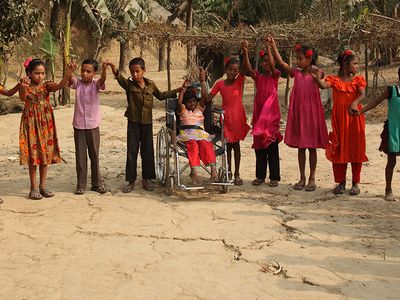
One of BEP's most commendable pillars is its commitment to inclusive education. BRAC ensures that children with disabilities — visual impairment, hearing loss, physical disabilities, and intellectual challenges — are not left out.
Through specialized training for teachers, adapted learning materials, assistive devices, and community sensitization programs, BRAC creates classrooms where every child learns together. This approach challenges deep-rooted stigma and proves that disability is not inability.
4. How BEP Reaches the Unreached
What makes BEP truly unique is its laser focus on inclusion and equity. The program is specifically designed to reach children who are invisible to the formal system:
- Children from ultra-poor families who cannot afford school supplies or uniforms
- Girls who face cultural barriers, early marriage risks, and safety concerns
- Children in remote and hard-to-reach areas where no government school exists
- Children with disabilities who are often excluded due to lack of facilities and awareness
- Children from ethnic minority communities who speak different languages
- Children in humanitarian crises — refugees, flood victims, and disaster-affected communities
5. Why BEP Matters: The Numbers
The impact of the BRAC Education Programme speaks for itself:
- 15+ million children educated to date
- 50%+ of all students are girls
- 3,000+ schools currently operating across Bangladesh
- 99.97% pass rate in government Grade V examinations (2015)
- 6% overall dropout rate — one of the lowest in the sector
- 6 million+ children graduated from pre-primary programs
6. Conclusion: Education as a Right, Not a Privilege
The BRAC Education Programme is more than a collection of schools. It is a philosophy — a belief that every child, no matter how poor, how remote, or how different, deserves the chance to learn, grow, and dream.
From a single room with one teacher and 33 children, to a global model replicated across multiple continents, BEP has proven that simplicity, community trust, and unwavering commitment can transform entire generations.